Pis’ma v ZhETF, vol. 110, iss. 11, pp. 748 - 749
© 2019 December 10
Superfluid3He in squeezed nematic aerogel
V. V. Dmitriev+1), M. S. Kutuzov∗, A. A. Soldatov+, A. N. Yudin+×
+P. L. Kapitza Institute for Physical Problems of Russian Academy of Sciences, 119334 Moscow, Russia
∗Metallurg Engineering Ltd., 11415 Tallinn, Estonia
×National Research University Higher School of Economics, 101000 Moscow, Russia
Submitted 3 November 2019
Resubmitted 4 November 2019
Accepted 5 November 2019
DOI: 10.1134/S0370274X19230061
Introduction. Nematic aerogels consist of nearly
measurements of spin diffusion in normal3He we have
parallel strands. In liquid 3He in these aerogels, the
determined effective mean free paths of3He quasiparti-
strands lead to an anisotropy of3He quasiparticle scat-
cles (at T = 0) along (λ∥) and normal (λ⊥) to z: λ∥ =
tering. It makes favorable new superfluid phases: polar,
= 900 nm, λ⊥ = 235 nm in mullite-F, and λ∥ = 550 nm,
polar-distorted A (PdA) and polar-distored B (PdB) [1].
λ⊥ = 130 nm in mullite-S.
Polar and PdA are Equal Spin Pairing (ESP) phases and
Theory. The strands fix m ∥ z and in the PdA
have the order parameter:
phase destroy the long-range order. As a result the 2D
Larkin-Imry-Ma (2D LIM) state is formed where ℓ is
Aνk = Δ0eiϕdν(amk + ibnk),
(1)
random in the plane normal to z [4, 5]. In isotropic 2D
where Δ0 is the gap parameter, eiϕ is the phase factor,
LIM state, projections of ℓ, averaged over space, are:
d is the unit spin vector, m and n are mutually or-
ℓ2x
= ℓ2y
= 1/2, ℓ2z
= 0. The squeezing along ŷ
thogonal unit orbital vectors, and a2 + b2 = 1. The PdA
orients ℓ, on average, along x ( ℓ2x
> 1/2, ℓ2y
< 1/2)
phase (a2 > b2) is an intermediate state between the po-
and changes NMR properties in the PdA phase [5] but
lar phase (a = 1, b = 0) and the A phase (a = b). PdA
does not in non-chiral polar phase.
and A phases are chiral with two nodes in the gap along
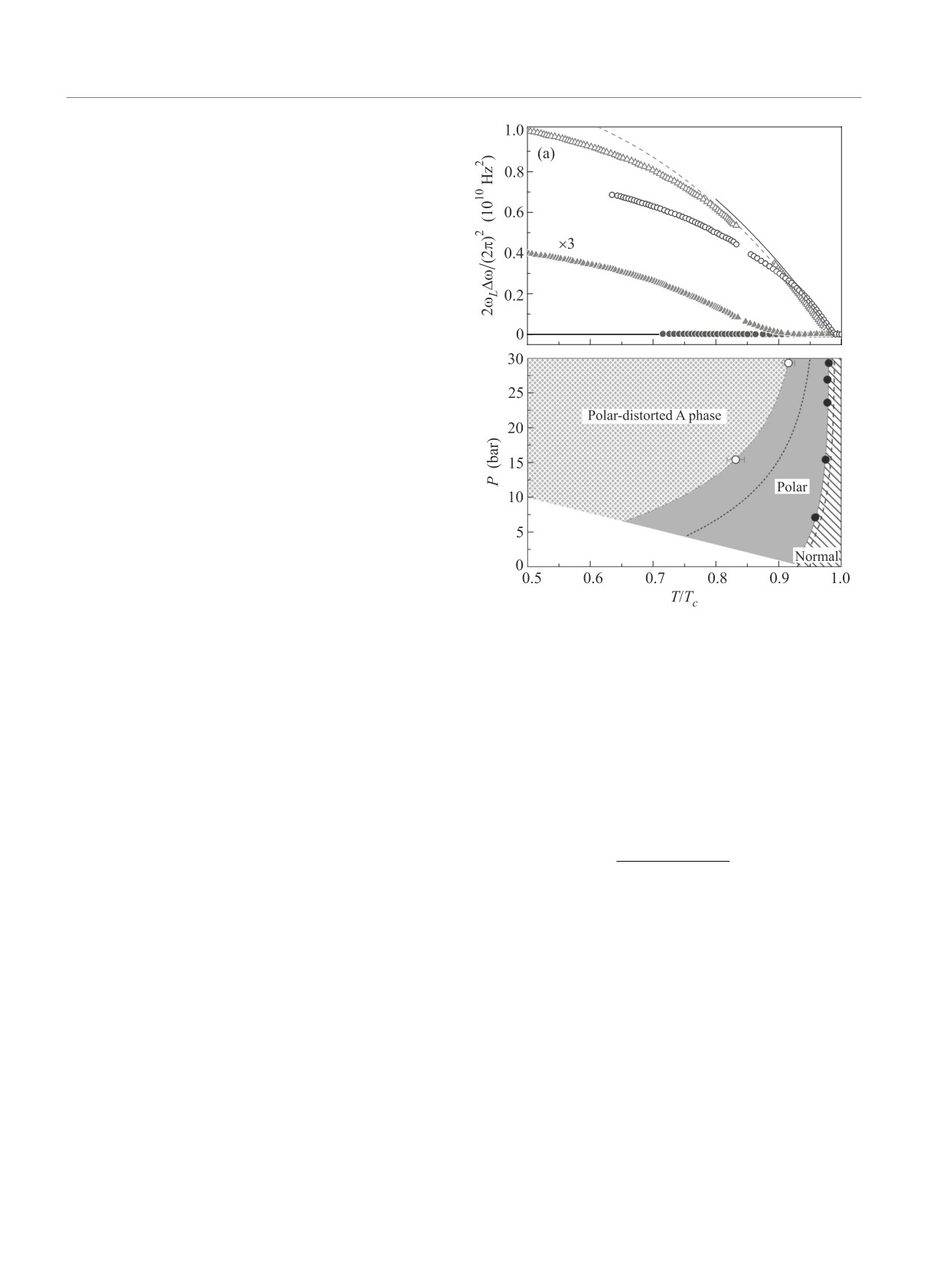
We identify the ESP phases by measuring cw NMR
ℓ = m×n. The polar phase has only one orbital vector
frequency shift (Δω) from the Larmor value (ωL). This
m, and its gap is zero in the plane normal to m. Previ-
shift in the isotropic 2D LIM state is given by [2, 5]:
ous experiments with3He in nematic aerogel were done
using Obninsk aerogel or nafen (with AlOOH or Al2O3
2ωLΔω = k(4 - 6b2)Ω2A cos2 µ = KΩ2A cos2 µ,
(2)
strands, respectively) of various porosities [2, 3]. It was
where ΩA is the Leggett frequency of the A phase,
found that the superfluid transition occurs into PdA or
K = k(4 - 6b2), and, in a weak coupling limit, k =
polar phases. On further cooling, transitions from polar
= 1/(3 - 4a2b2). If the transition temperatures of bulk
to PdA, and then to PdB phases were observed. Here
3He (Tc) and of3He in aerogel (Tca) are close, then
we investigate the ESP phases in a new nematic aerogel
ΩA(T/Tca)/ΩA0(T/Tc) = Tca/Tc [3], where ΩA0 is the
with mullite strands. This aerogel is closer to an ideal
Leggett frequency of bulk3He-A, which is known. Then
array of parallel cylinders, as it is more transparent and
measurements of Δω allow to find K and identify the
easily splits along the strands. The mullite aerogel has
phases (in the A phase K = 1/2, in the polar phase
an overall density 150 mg/cm3, porosity ≈ 96 %, and di-
K = 4/3). However, the weak coupling works well only
ameter of strands ≲ 10 nm. We use two samples with
at low pressures, so at high pressure we should use ex-
a cuboid shape of sizes 3-4 mm: undeformed (mullite-
perimentally found K in the polar phase (Kp) which
F) and unidirectionally squeezed by 30 % transversely
decreases from 4/3 at 0 bar to 1.15 at 29.3 bar [3].
to the strands (mullite-S). In particular, we investigate
In the anisotropic 2D LIM state the shifts Δω∥ (at
how the squeezing changes properties of chiral PdA and
µ = 0) and Δω⊥ (µ = π/2 and H ∥ ŷ) are given by [5]:
non-chiral polar phases.
Methods. Experiments were done at 7.1-29.3 bar
(
)
2ωLΔω∥ = 4
1-b2 -b2 ℓ2y
kΩ2A, µ = 0,
(3)
using cw NMR in fields 139-305 Oe at different angles
(
)
µ between the field H and the strands direction z. In
2ωLΔω⊥ = 4b2
1-2 ℓ2y
kΩ2A, µ = π/2.
(4)
order to avoid surface solid3He on the strands, they
It follows from Eq. (4) that there is a qualitative dif-
have been covered by ∼ 2.5 atomic layers of4He. By
ference between PdA and polar phases: in the polar
1)e-mail: dmitriev@kapitza.ras.ru
phase Δω⊥ = 0, while in the PdA phase Δω⊥ = 0.
748
Письма в ЖЭТФ том 110 вып. 11 - 12
2019