Pis’ma v ZhETF, vol. 118, iss. 10, pp. 721 - 722
© 2023 November 25
Spreading widths of giant monopole resonance in the lead region:
Random matrix approach
N. N. Arsenyev+, A. P. Severyukhin+∗, R. G. Nazmitdinov+∗1)
+Bogoliubov Laboratory of Theoretical Physics, Joint Institute for Nuclear Research, 141980 Dubna, Russia
∗Dubna State University, 141982 Dubna, Russia
Submitted 3 October 2023
Resubmitted 13 October 2023
Accepted 17
October 2023
DOI: 10.31857/S1234567823220032, EDN: piipnj
The general idea on Giant Resonance (GR) decay
(QRPA) in very large two-quasiparticle spaces. To con-
properties as a consequence of the coupling of high-lying
struct wave functions of the excited 0+ states up to
modes with the lowest collective vibrational modes [1-4]
20 MeV we take into account all two-phonon terms that
requires further development in light of discussion on the
are built from the phonons of different multipolarities
role of order and disorder (chaos) in nuclei [5, 6]. We
λπ = 0+, 1-, 2+, 3-, 4+, coupled to 0+ state (see de-
recall, however, that the analysis of spreading widths,
tails in [23, 17, 24]). Following the basic ideas of the
associated with the cascade of couplings and their frag-
quasiparticle-phonon model [4], the Hamiltonian is then
mentations due to these couplings (cf. [7-10]), is a real
diagonalized in a space spanned by states composed of
challenge for nuclear structure theory. Nowadays, most
one and two phonons coupled by means of the micro-
successful attempts in this direction are restricted by
scopic coupling matrix elements (see details in [20, 25]).
the consideration of the microscopic coupling between
In the item ii) the statistical description of the GMR
one-phonon and two-particle-two-hole (2p - 2h) or two-
fragmentation is based on ideas from the RMT [26, 27].
phonon configurations (see, e.g., discussion in [11-17]).
Namely, the one-phonon states are generated by means
In this paper we suggest the alternative approach,
of the QRPA calculations, while the coupling matrix el-
based on ideas of the Random Matrix Theory (RMT)
ements between the one-phonon and two-phonon states
[18, 19], which enables us to count effectively the prob-
are replaced by random matrix elements of the Gaus-
lem of the hierarchy at the description of spreading
sian Orthogonal Ensemble type. Within the framework
widths. To provide a detailed overview of our ap-
of our approach the two-phonon model space is decom-
proach we consider only spherical or near-spherical nu-
posed on two subspaces that are differently coupled to
clei around208Pb and focus our attention on the spread-
the QRPA states. On the larger energy scale the gross
ing width of Giant Monopole Resonances (GMRs). To
structure and structure effects of the GMRs are de-
demonstrate the validity of our approach we compare
fined; that includes the random coupling to surface vi-
the results of: i) the microscopic calculations, based on
brations of a few strongest coupling matrix elements.
the coupling between one-phonon and two-phonon con-
On the smaller energy scale there is the random cou-
figurations, so called phonon-phonon coupling (PPC);
pling to surface vibrations of a majority (small) matrix
ii) the random matrix approach based on the one-
elements. This coupling is particularly responsible for
phonon approximation; iii) available experimental data
the fine structure of the strength function in the energy
for204,206,208Pb nuclei.
region around the GMR.
To carry out the item i) we employ the modern
To illustrate the quality of our approach, all numer-
development of the quasiparticle-phonon model, where
ical calculations have been done on the basis of the
the single-particle spectrum and the residual interac-
Skyrme forces SLy4 [28, 29]. Switching on the strong
tion are determined making use of the Skyrme inter-
as well as the week interactions, with the chosen values
action without any further adjustments [20]. By means
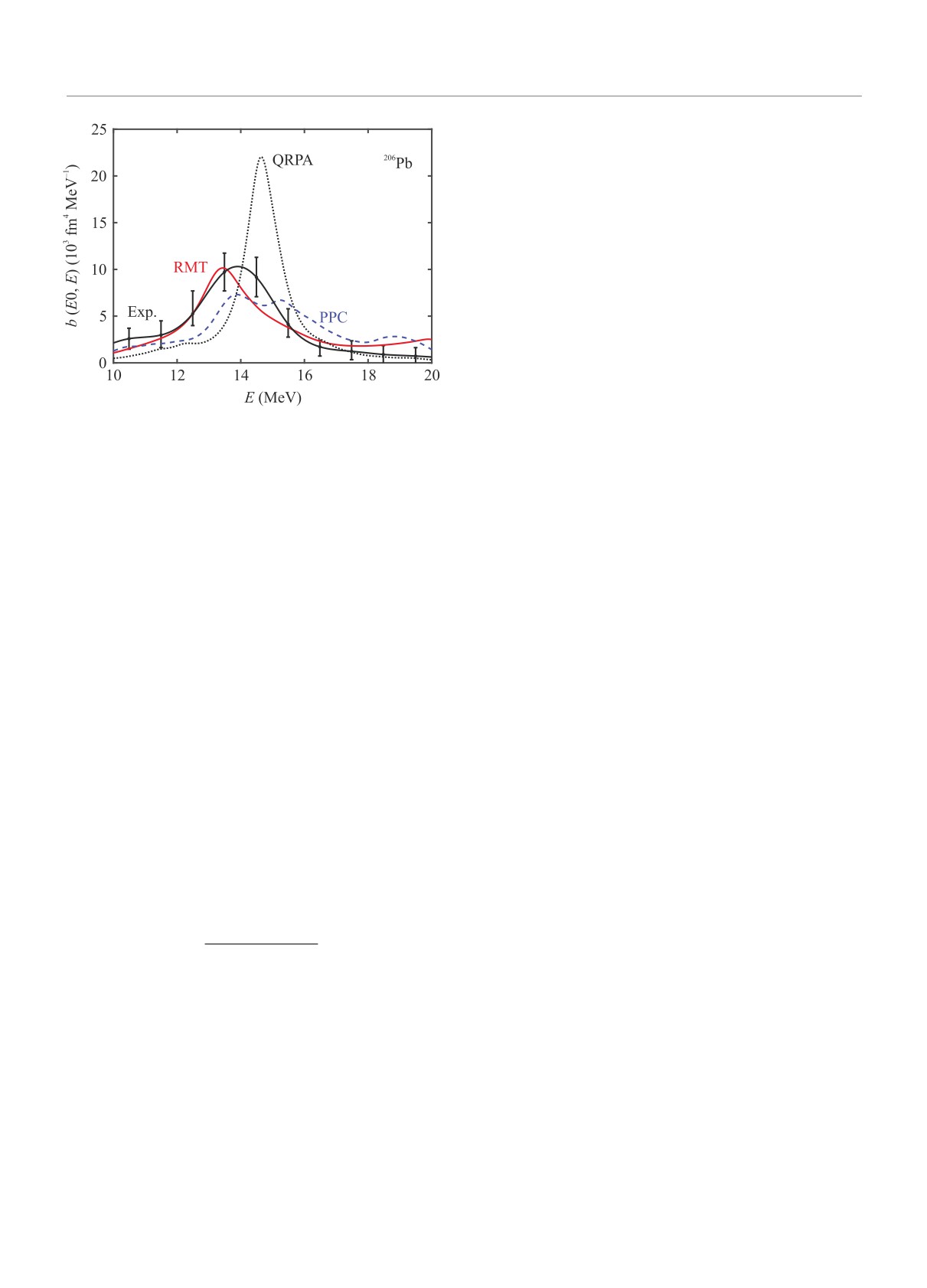
σ1 = 600 keV and σ2 = 30 keV, the RMT results are
of the finite rank separable approximation [21,22] for
in a quite good agreement with those of the PPC (see
the residual interaction we perform the calculations
Fig. 1). It is notable that the strength distribution of the
within the quasiparticle random phase approximation
GMR, obtained in this case, is rather close to the ex-
perimental distribution [30]. The remarkable agreement
1)e-mail: rashid@theor.jinr.ru
between the results of the PPC and the RMT calcula-
Письма в ЖЭТФ том 118 вып. 9 - 10
2023
721