Pis’ma v ZhETF, vol. 118, iss. 10, pp. 733 - 734
© 2023 November 25
Rattling phonon modes in quadruple perovskites
Z.V.Pchelkina+∗, E.V.Komleva+∗, V.Yu.Irkhin+, Y.Long×◦, S.V.Streltsov+∗1)
+Institute of Metal Physics, 620108 Ekaterinburg, Russia
∗Department of Theoretical Physics and Applied Mathematics, Ural Federal University, 620002 Ekaterinburg, Russia
×Institute of Physics, Chinese Academy of Sciences, 100190 Beijing, China
◦Songshan Lake Materials Laboratory, Dongguan, 523808 Guangdong, China
Submitted 9 October 2023
Resubmitted 9 October 2023
Accepted 23
October 2023
DOI: 10.31857/S1234567823220068, EDN: piorrc
Anharmonic vibrations of weakly bound ions in an
The crystal structure of quadruple perovskites
oversized atomic cage formed by the other atoms are
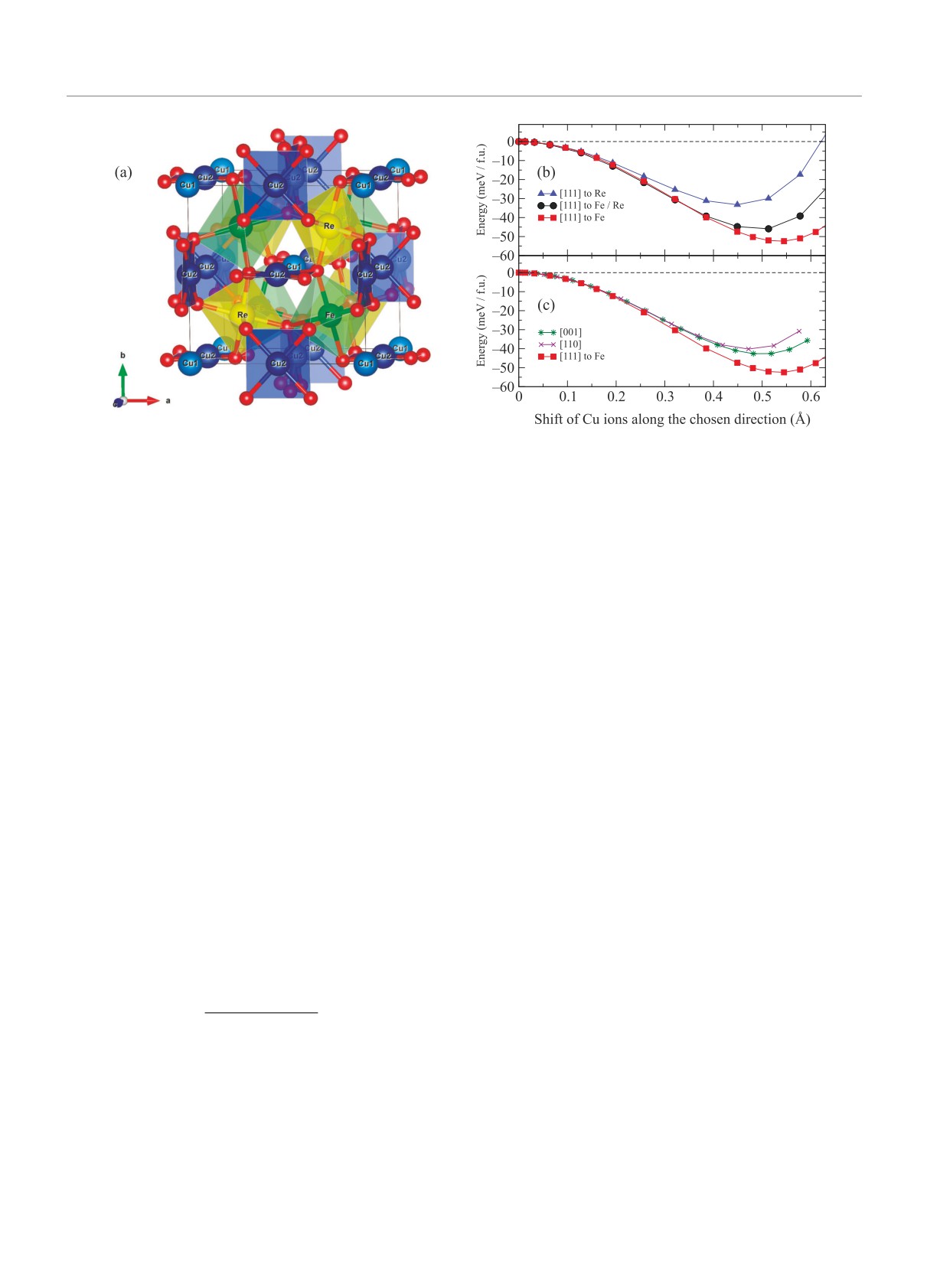
AA’3B4O12 on example of CuCu3Fe2Re2O12 is shown
commonly known as rattling. They have been observed
in Fig. 1a. CuCu3V4O12 has a similar structure with
in materials such as VAl10+δ [1], clathrates [2], dode-
V ions occupying both octahedral positions. Crystallo-
caborides [3], filled skutterudites [4], β-pyrochlore ox-
graphically, there are two different Cu positions. Our
ides [5]. Rattling or other types of anharmonicity can
calculations, as well as previous results [17] show that
lead, e.g., to Schottky-type anomaly of specific heat at
Cu at A sites (i.e. those, which are in icosahedra) have
low temperature [6], result in significant increase of elec-
3d10 electronic configuration, i.e., these are Cu1+ ions.
tron effective mass [7-9], suppress thermal conductiv-
Cu ions at A′ site have local magnetic moment and
ity [10, 11] or be a driving force for the superconductiv-
these are Jahn-Teller active Cu2+ ions.
ity [7-9, 12].
In CuCu3V4O12 distance between Cu1+ and sur-
Recently, the rattling has been suggested for quadru-
rounding oxygen ions (2.548Å) is much larger than the
ple perovskite CuCu3V4O12 synthesized under a high-
sum of corresponding ionic radii 2.13Å [18]. This is the
pressure [13]. In quadruple perovskites AA’3B4O12 the
reason why there develops a localized phonon mode with
A site ions are icosahedrally (twelve neighbors) coordi-
Cu vibrating in this large O12 cage, a rattling mode.
nated by oxygen atoms. The thermal displacement pa-
The dependence of DFT + U total energy on Cu1+ dis-
rameter of Cu ions at A site in CuCu3V4O12 was found
placement has a minimum at ∼0.35Å distortion. Thus
to be quite large, Uiso ≈ 0.045Å2 at 300 K. Together
our calculations directly demonstrate presence of the
with unusual behavior of specific heat Cp(T ) this led to
rattling mode in CuCu3V4O12. Moreover, this mode
suggestion of possible rattling in CuCu3V4O12 [13].
does not seem to be specific for this particular mate-
In the present paper we report direct evidence of a
rial, and therefore we tested whether rattling vibrations
rattling mode in CuCu3V4O12 and another recently syn-
are present in another quadruple perovskite, namely, re-
thesized quadruple perovskite CuCu3Fe2Re2O12. The
cently synthesized CuCu3Fe2Re2O12 [16].
total energy density functional theory (DFT) calcula-
There are several possible types of rattling. Indeed,
tions clearly show rattling distortions along [111] direc-
as one can see from Fig.1a there are two Cu1 ions in the
tion related to the Cu vibration.
unit cell: those sitting in the center of cube and in its
The electronic structure calculations were performed
corners. Therefore, rattling distortions of these two Cu1
in the local density approximation taking into account
ions can be in the same [111] direction (in-phase distor-
Coulomb repulsion within LDA + U method [14] using
tion), or in the opposite directions when we have two
the Vienna ab initio simulation package (VASP) [15].
different Cu1-Cu1 distances (out-of-phase distortions).
The experimental crystal structure data with the space
Moreover, there are two inequivalent by symmetry out-
groups Im3 (#204) and Pn3 (#201) reported in [13]
of-phase distortions with Cu1 ions moving to Fe or Re
and [16] for CuCu3V4O12 and CuCu3Fe2Re2O12, re-
ions between them. Fig. 1b summarizes results of calcu-
spectively, were used.
lations for these 3 types of possible rattling distortions.
One can see that this is the out-of-phase distortion to
1)e-mail: streltsov@imp.uran.ru
Fe ions, which gives the lowest total energy.
Письма в ЖЭТФ том 118 вып. 9 - 10
2023
733